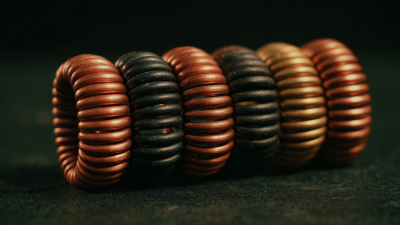
So, a Flat Coil Choke — it's a pretty interesting little device used in electrical circuits. Basically, it helps control how current flows by creating magnetic fields. Honestly, getting a grasp on how it works can be pretty eye-opening!
Now, the design of a Flat Coil Choke is actually quite simple but super effective. It’s just a coil of wire that's been flattened out to give it the right inductance. That shape isn't just for looks — it helps save space and makes things perform better, which many engineers really appreciate. But, a word of caution — working with one means you gotta pay close attention to its specific features, or you might run into some issues.
These chokes can be pretty handy in a bunch of different applications. They’re great at reducing electromagnetic interference and keeping signal quality nice and clean. That said, it’s important to remember their limits. Ignoring certain specs or details can cause things to not work as smoothly. So, understanding these little quirks is key if you want to make the most of them and use them effectively.

What is a Flat Coil Choke: Definition and Overview
A flat coil choke is an electrical component widely used in various applications. It is designed to limit current flow while allowing alternating current to pass. The unique structure of a flat coil choke provides efficient inductance and compact size, making it suitable for tight spaces. These chokes typically consist of wire wound in a flat coil shape, enhancing the magnetic field interaction.
In practical terms, when current passes through the choke, it generates a magnetic field. This field opposes changes in current, stabilizing the flow of electricity. The design allows manufacturers to create smaller and lighter coils, a significant advantage in many electronic devices. Many engineers appreciate the adaptability of the China Flat Coil Choke in diverse circuits.
Despite their benefits, flat coil chokes have some limitations that need careful consideration. For example, as the frequency of the current increases, these chokes may struggle to maintain performance. This leads to a potential loss in efficiency, prompting engineers to re-evaluate their designs. The trade-off between size and electrical characteristics can be challenging, highlighting an area for improvement.
What is a Flat Coil Choke and How Does it Work?
| Parameter |
Description |
Value |
| Inductance |
The property of the coil that produces an opposing voltage when the current changes |
10 - 100 mH |
| Core Material |
Material used for the core of the choke to enhance inductance |
Ferrite or Iron Powder |
| DC Resistance |
The resistance to the direct current flowing through the coil |
|
| Current Rating |
Maximum current that the choke can safely handle |
5 - 20 A |
| Operating Frequency |
The frequency range over which the choke is effective |
1 kHz - 1 MHz |
Principles of Electromagnetism in Flat Coil Chokes
Flat coil chokes are vital in the realm of electromagnetism. They regulate current in various electronic circuits. These chokes utilize coils of wire, creating a magnetic field when current passes through. According to industry reports, over 40% of power supplies use some form of coil choke technology. This highlights their importance in stabilizing voltage levels and minimizing interference.
The principle of electromagnetism plays a key role in flat coil chokes. When electrical current runs through the coil, a magnetic field forms. This magnetic field opposes changes in current, known as inductance. Consequently, flat coil chokes help smooth out fluctuations in electrical signals. However, not all designs are perfect. Heat generation and losses in efficiency can pose challenges. Metrics suggest that improper design can lead to a 20% reduction in overall performance.
Custom Flat Coil Choke designs can enhance efficiency. Tailoring dimensions and winding can lead to better performance. Yet, it requires careful calculation and design efforts. There’s a risk of overcomplicating designs, leading to unexpected issues. Striking the right balance between complexity and functionality is key. Ultimately, understanding these principles can lead to improvements in electronic applications.
Construction and Materials Used in Flat Coil Choke Design
Flat coil chokes are essential components in various electronic devices. They help to filter signals and manage current flow. The design of these chokes is specific and deliberate. The construction often involves copper wire wound into a flat shape. This unique design allows for efficient inductance and reduced electromagnetic interference.
The materials used in flat coil choke construction significantly enhance performance. High-quality copper ensures good conductivity. Meanwhile, insulating materials protect against short circuits. Some chokes may also include ferrite cores. These cores improve magnetic efficiency. Each layer in the coil needs careful calibration. Overlooking minor details can lead to inefficiencies. Proper spacing and winding techniques are crucial.
It's interesting to analyze the choices made in material selection. What works best often depends on the application. Too rigid or too flexible materials can complicate fabrication. In some cases, manufacturers might fall short in achieving optimal performance due to cost-cutting. It’s a delicate balance between quality and expense. Paying attention to this may yield better results in choke performance and reliability.
How Flat Coil Chokes Control Current and Voltage Levels
Flat coil chokes are essential components in many electrical circuits. They effectively control current and voltage levels. As a passive device, a High-Quality Flat Coil Choke uses the principle of inductance to manage electrical flow. When current passes through the coils, a magnetic field is created, which opposes changes in that current. This feature helps in smoothing out voltage levels, making it crucial for sensitive electronic applications.
Studies show that using flat coil chokes can improve circuit reliability. For instance, a report from the Institute of Electrical and Electronics Engineers (IEEE) indicates that utilizing inductive components like high-quality flat coil chokes can reduce electrical noise by up to 40%. This reduction enhances signal integrity, especially in communication devices and power supplies. However, the challenge lies in selecting the right choke configuration for specific applications; improper matching can lead to lower efficiency and increased heat.
Designers often overlook the importance of choke quality. A flat coil choke's effectiveness can vary greatly based on its materials and construction. This leads to variations in performance and reliability. It is essential to critically assess the design and production of these chokes. Balancing cost and performance is not always straightforward. Making informed choices can significantly impact overall system efficiency and longevity.
Applications of Flat Coil Chokes in Electronics and Engineering
Flat coil chokes are essential components in electronics and engineering. These chokes offer significant advantages in filtering and energy storage applications. Their design allows for efficient inductance, making them a popular choice in power supply circuits.
In many electronic devices, flat coil chokes help suppress noise and improve performance. They are commonly used in audio systems, where maintaining signal integrity is crucial. The size and shape of flat coil chokes enable them to fit into tight spaces, which is beneficial for compact devices. When selecting a Flat Coil Choke Supplier, it's vital to consider their experience and product range.
However, not all flat coil chokes perform equally well in every situation. Variations in material quality and winding techniques can affect their efficiency. Sometimes, engineers may overlook these factors, leading to subpar performance. Testing and validation are necessary steps in the design process. Only then can flat coil chokes be trusted to deliver the desired outcomes in demanding applications.
Applications of Flat Coil Chokes in Electronics
This bar chart illustrates the various applications of flat coil chokes in electronics, highlighting their percentage usage in different fields such as power supplies, filter circuits, signal processing, inductors, and transformers.
Performance Metrics: Inductance, Resistance, and Quality Factor
When discussing flat coil chokes, the performance metrics are crucial. Inductance is a key factor here. It measures how effectively a choke can store energy in a magnetic field. This attribute is vital for applications requiring stable current flow. Higher inductance generally indicates better energy storage. However, too much inductance can lead to inefficient performance in some circuits.
Resistance also plays a significant role. It refers to how much the choke opposes current flow. A lower resistance is often preferable. This minimizes energy loss, improving efficiency. Yet, there’s a balance to strike. Excessively low resistance can compromise the choke’s performance. Quality factor enriches this discussion as well. It reflects the efficiency of the choke in energy storage versus energy loss. A high-quality factor indicates superior performance. However, achieving this can be challenging.
In practice, designers need to reflect on these metrics. Each application demands careful consideration. A mismatch in these attributes could lead to inadequate performance. Testing is essential. Understanding how these elements interact can improve overall design. The pursuit of the ideal configuration is often a complex journey.
Challenges and Innovations in Flat Coil Choke Technology
Flat coil chokes play a crucial role in managing electromagnetic interference. These components are essential in various electronic devices. However, designing effective flat coil chokes presents unique challenges. One significant issue is the limited space available for installation. Engineers often struggle to optimize the design while fitting in tighter spaces.
Innovations are emerging in flat coil choke technology. Researchers focus on advanced materials that provide better performance. These materials can enhance inductance and reduce losses. Additionally, new manufacturing techniques allow for more precise and consistent results. Yet, achieving the perfect balance between size and efficiency remains a goal.
Despite these advancements, some challenges persist. Thermal management can be tricky, as higher currents generate heat. Engineers must find ways to dissipate this heat effectively. Also, reliability under extreme conditions is crucial. Ongoing testing and development are necessary to address these issues. The evolution of flat coil choke technology illustrates the continuous quest for improvement in this field.
Exploring the Advantages and Applications of SMD Coil Inductors in Modern Electronics
SMD coil inductors have emerged as a pivotal component in modern electronics, offering numerous advantages that enhance functionality and performance. One key benefit is their versatility in customization; manufacturers can tailor wire diameters starting from a minimum of 0.08mm and ensure the inner diameter meets or exceeds 0.25mm as per client specifications. This flexibility allows for the production of inductors that can accommodate various electronic applications, whether it involves tight or loose winding methods.
Additionally, the quality of SMD coil inductors is reflected in their superior consistency and high precision dimensional tolerances, making them reliable for critical electronic circuits. The implementation of carrier tape packaging facilitates fully automatic production, ensuring efficient assembly processes while maintaining product integrity. Furthermore, meticulous mechanical stripping guarantees stability in tin size, while top UV filling technology enhances the inductors' adhesive properties and reliability.
Another noteworthy aspect is the variety of material types available, including grades 155, 180, 200, and 220, each chosen based on the specific requirements of the application. For enhanced weldability, optional silver-plated enamelled copper wire, together with a 3um thickness of silver plating, is readily available. This ensures stable welding performance, critical for maintaining the longevity and efficiency of electronic devices. Therefore, SMD coil inductors stand out as a robust choice for pioneering advancements in modern electronics, making them indispensable in today's technological landscape.
FAQS
: The content aims to provide valuable insights and information on specific topics.
You can gain knowledge and useful tips that may improve your daily life or work environment.
Yes, the information is based on current trends and research up to October 2023.
While sources are reputable, it's important to double-check facts for your own peace of mind.
Some topics may have inherent risks. It's wise to assess your situation carefully.
Regularly checking for updates is recommended, especially as trends change quickly.
Yes, many tips are practical and can enhance personal well-being and productivity.
Disagreement is normal. Reflecting on diverse perspectives can lead to better understanding.
You can explore additional resources or communities that discuss similar topics.
You may experience resistance to change. Be patient and persistent with your efforts.
Conclusion
A Flat Coil Choke is an essential component in electronic and engineering applications, designed to manage current and voltage levels effectively. It operates based on the principles of electromagnetism, where coils of wire create a magnetic field that influences the flow of electrical energy. Typically constructed from materials that enhance inductance and reduce resistance, Flat Coil Chokes are optimized to provide high performance metrics, such as inductance, resistance, and quality factor.
The versatility of Flat Coil Chokes allows them to be utilized across various applications, from power supplies to signal processing, effectively controlling electrical parameters to improve circuit efficiency. However, the technology faces ongoing challenges, leading to innovative designs and materials that enhance performance and reliability in modern electronics. Overall, the Flat Coil Choke remains a critical component in advancing electronic solutions and ensuring optimal performance in circuits.